
An emergency near the tracks? Act immediately.
Move people away from danger, call 911 for a life-threatening situation, and use the blue-and-white Emergency Notification System sign at a public crossing to contact the railroad responsible for that location.
Get out. Get away. Make the call.
Do not remain inside the vehicle while trying to restart or move it. Trains can approach at any time and cannot stop quickly.
Get out immediately
Evacuate every passenger. Leave personal belongings behind and do not delay while attempting to move the vehicle.
Move far away
Move everyone well away from the tracks and the vehicle. Remain alert for trains on any track and in either direction.
Use the ENS sign
Call the phone number on the blue-and-white sign and provide the crossing ID. If no sign is visible, or anyone is injured or in immediate danger, call 911.
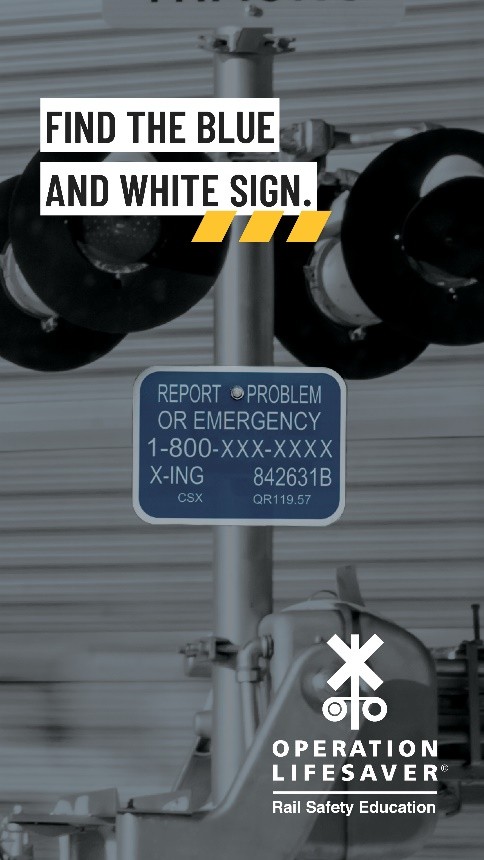
Find the blue-and-white sign at the crossing.
Emergency Notification System—or ENS—signs are posted at or near public highway-rail crossings. They provide the direct emergency phone number for the railroad responsible for the crossing and the unique U.S. DOT crossing number.
Use the sign to report a vehicle, object, person, damaged crossing device, or other urgent problem on or near the tracks. Give the dispatcher the crossing ID exactly as it appears on the sign.
Use the crossing sign or 911 whenever safety is at risk.
Do not enter railroad property or approach equipment, damaged infrastructure, spilled material, or a person on the tracks.
Vehicle or equipment on the tracks
Get everyone away, call the ENS number, provide the crossing ID, and call 911 when there is immediate danger or injury.
Crossing signal or gate problem
Safely report damaged, malfunctioning, or continuously activated warning devices using the ENS sign at the crossing.
Person, animal, or obstruction
Do not attempt a rescue on railroad property. Call 911 and the railroad using the ENS information when available.
Fire, spill, collision, or derailment
Move to a safe location, call 911, avoid smoke or spilled material, and follow instructions from emergency responders.
Accurate location information can save critical time.
Railroad locations can be difficult to describe. Use the crossing sign and nearby landmarks to provide the clearest location possible.
Do not assume train movements have stopped.
Tracks remain active until the responsible railroad confirms that train traffic has been stopped or protected. Locate the blue-and-white ENS sign and communicate its telephone number and crossing ID through the incident command or dispatch center.
Operation Lifesaver offers specialized railroad incident and safety training for law enforcement, firefighters, dispatchers, and other emergency personnel.
Follow your railroad-specific procedures.
This public page does not replace job briefings, operating rules, emergency plans, contractor orientation, supervisor instructions, or internal notification and incident-reporting requirements.
Additional information for the public, contractors, and communities.
Need safety information, a presentation, or help planning work near the railroad?
Contact LA&L for non-emergency safety questions, contractor coordination, community education, or planned work near railroad property. Do not use the general contact form for an active emergency.